Teeth whitening Dubai works best when you know three things going in: whether you’re actually a good candidate, what affects the price, and how long the results will hold up. Skip that homework, and you risk paying for a treatment that doesn’t match your stain type, or discovering only after treatment that your teeth aren’t candidates at all. Here’s what to check before you book, from the questions patients ask most at Minha Dental Clinic in Deira.
Are You a Good Candidate for Teeth Whitening?
Good candidates for teeth whitening have healthy gums, no untreated cavities, and natural enamel without crowns, veneers, or bonding on visible teeth. Whitening gel only works on natural tooth structure, so it won’t lighten dental work or teeth with deep intrinsic stains.
A safe teeth whitening treatment always starts with a dental check-up to rule out cavities and gum disease, not straight to a shade consultation. Your dentist needs to rule out decay and inflammation first — whitening gel on unhealthy teeth can make sensitivity worse and won’t give you an even result anyway.
Quick checklist before you book:
- No untreated cavities or gum disease
- No visible crowns, veneers, or bonding on front teeth (these won’t whiten to match)
- Stains are extrinsic (surface-level, from coffee/tea/smoking) rather than intrinsic (from medication, trauma, or genetics)
- Not currently pregnant or breastfeeding
Having crowns, veneers, or intrinsic stains doesn’t rule out a brighter smile — it means whitening isn’t the right first treatment, and options like veneers or bonding may work better instead.
What Affects the Cost of Teeth Whitening Dubai?
Teeth whitening prices in Dubai vary widely by clinic, and the final cost depends on three things: how stained your teeth are, whether you choose in-office or take-home treatment, and how many sessions you need. Dubai clinics use different systems — Zoom, laser, LED, and custom home trays — and each is priced differently, which is why cost varies more here than for most dental treatments.
In-office treatment costs more per visit but delivers results in one sitting. Take-home kits are cheaper upfront but need consistent daily use over one to two weeks to reach the same result. The only way to get an accurate number for your own teeth is a shade consultation, since staining severity changes the price more than anything else.
Be cautious of the under-Dh100 whitening deals sold through daily-deal sites. These skip the dental check-up entirely, which means you have no way of knowing if whitening is even safe for your teeth — and the trays are rarely fitted to your mouth, which raises the risk of gum irritation.
In-Office vs. Home Teeth Whitening — Which Is Better?
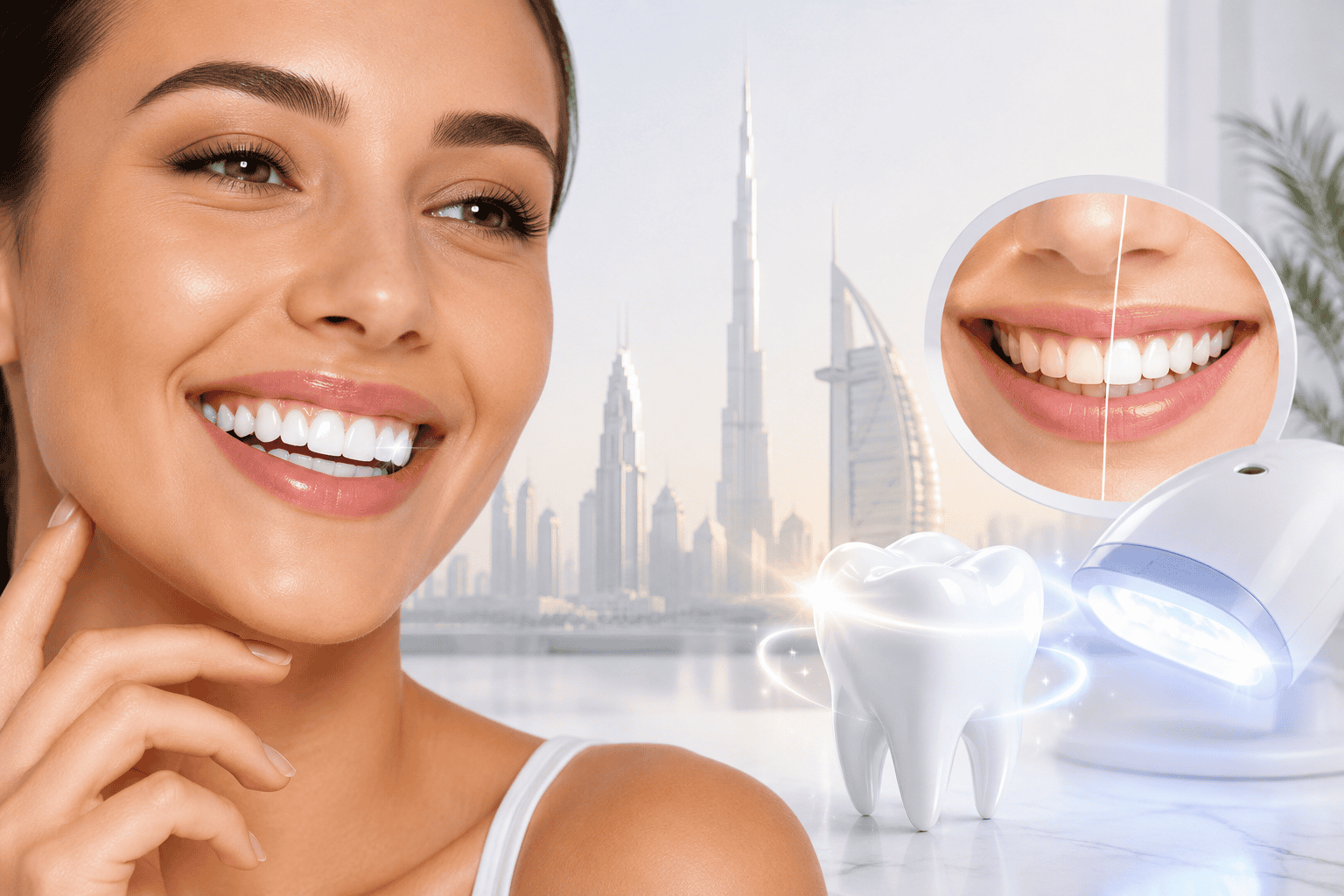
In-office whitening wins on speed and results; home whitening wins on cost and convenience. In-office treatment gives faster, dentist-supervised results — often 6 to 8 shades whiter in a single 60–90 minute visit — while home whitening takes one to two weeks of daily wear but fits around your schedule.
| Method | Time to results | Shades achieved | Supervision | Relative cost |
| In-office (professional) | 1 visit, 1–2 hours | Up to 6–8 shades | Full dentist supervision | Higher |
| Home whitening kit | 1–2 weeks, daily wear | 3–5 shades (typical) | Dentist-fitted, self-applied | Lower |
If you want whiter teeth before a wedding, work trip, or Eid gathering and need guaranteed results fast, in-office is the safer bet. If you’re whitening for general maintenance and don’t mind a slower timeline, a dentist-fitted home kit does the job at a lower cost.
Is Teeth Whitening Safe? What Are the Side Effects?
The two most common side effects are tooth sensitivity and mild gum irritation, both of which are temporary when the treatment is performed by a dentist. They usually fade within a day or two of finishing treatment.
Dentists explain that sensitivity happens because the whitening gel temporarily opens the pores in your enamel. A dentist controls the gel concentration and exposure time to keep this manageable; something over-the-counter kits can’t calibrate for your specific teeth.
UAE dentists have flagged a real risk with over-the-counter whitening: ill-fitting trays and unregulated gel strength can lead to more serious enamel sensitivity than professional treatment ever would. Dr. Khulood Bin Haider, a dentist with the Dubai Health Authority, has advised that whitening treatments should be spaced at least a year apart rather than repeated every few months for a “top-up” glow.
How Many Shades Whiter Will My Teeth Get?
Whether whitening will noticeably change your smile depends on the type of stain: extrinsic stains respond well; intrinsic stains don’t. Most patients see a visible improvement with in-office whitening, though your starting shade and stain type decide how far your teeth can lighten.
Extrinsic stains — the kind that build up from coffee, tea, red wine, and smoking — respond well to whitening because they sit on the surface. Intrinsic stains, caused by things like tetracycline use in childhood or trauma to a tooth, sit deeper in the dentin and don’t lighten the same way.
A shade guide taken before and after treatment shows exactly how many shades whiter your teeth have become — your dentist should show you your starting shade and your target shade before you commit to a plan.
How Long Do Teeth Whitening Results Last?
Results typically last anywhere from 6 months to 2 years, and the single biggest factor is your diet afterward. Coffee, tea, red wine, and smoking are the fastest ways to undo a whitening treatment.
For the first 48 hours after treatment, your enamel is more porous and stains more easily than usual. This is the window to be strictest about what you eat and drink. After that, normal habits apply: rinse after dark drinks, brush twice a day, and don’t skip your six-month cleaning.
A touch-up session every 6 to 12 months keeps results consistent without needing a full treatment each time. Regular cleanings alone also help plaque and surface buildup dull your shade even without new staining.
How Do You Choose the Right Dental Clinic for Teeth Whitening in Dubai?
Before you book anywhere, check three things: a licensed dentist who checks your oral health before treatment, transparent pricing with no hidden add-ons, and dentist-supervised products rather than generic over-the-counter gel.
Walk-in kiosks and daily-deal whitening stalls typically skip the dental check-up, publish no clear pricing, and use unsupervised over-the-counter gel. There’s often no dentist present during treatment, and no way to know what’s actually in the whitening gel being used on you.
At Minha Dental Surgery Clinic, every whitening treatment starts with a check-up and shade consultation, so you know exactly what result to expect and whether whitening is the right call before you spend anything.
FAQ
Is teeth whitening painful?
No — most patients feel mild, temporary sensitivity rather than pain. It typically settles within a day or two of finishing treatment.
Can I whiten my teeth if I have crowns or veneers?
Whitening gel won’t change the colour of crowns or veneers, so results will look uneven if you have them on visible teeth. Talk to your dentist about matching options instead.
How soon can I drink coffee or tea after whitening?
Wait at least 48 hours. Your enamel is more porous right after treatment and stains more easily during this window.
Is teeth whitening safe during pregnancy?
Most dentists advise waiting until after pregnancy, purely as a precaution — this is standard clinical guidance rather than evidence of harm.
How much does teeth whitening cost in Dubai on average?
Prices vary by clinic and method — home kits generally cost less but take longer, while in-office whitening costs more upfront and gives faster results. Your dentist can give you an exact quote after a shade consultation, once they’ve assessed your teeth and staining.